Al Khafji – SWRO desalination plant supplemented with the SINAMICS PERFECT HARMONY GH180 converters
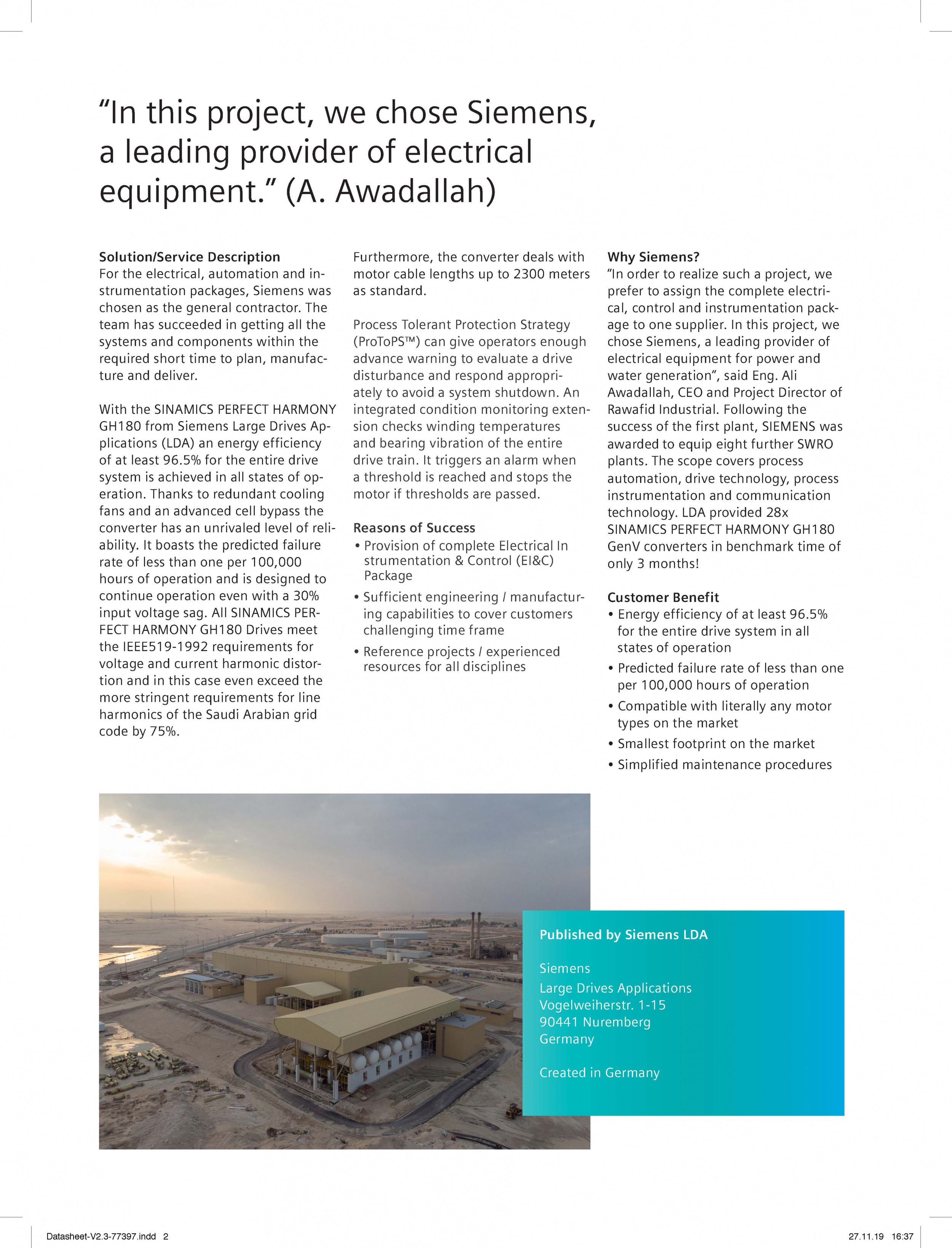
Al Khafji – SWRO desalination plant supplemented with LDA products
Water
KACST
Ar Raid, Riyadh 12354, Saudi Arabia
Completion: 2019
Al Khafji
Al Khafji, Saudi Arabia
Customer Situation / Objectives
Saudi Arabia is an extremely hot, arid country and water scarcity has been a challenge for centuries. The most common way to supplement insufficient water supply is to purify seawater through desalination.
Close to the city Al Khafji KACST (King Abdulaziz City for Science and Technology) build the world’s largest solar-powered sea water reverse osmosis (SWRO) desalination plant. The plant receives power from a neighboring solar power plant with a connected capacity of 20 megawatts and is designed to produce 60,000 cubic meters of fresh water per day covering demand of 150,000 people and which can be further extended to produce 90,000 cubic meters per day. The plant operation is based on available solar energy, so that the largest possible share of sustainable energy is used for water production. This not only leads to significant CO2 savings, but also to lower operating costs.
The ambitious project was developed and implemented by the water desalination experts of Rawafid Industrial and Advanced Water Technology (AWT). The engineers had several compatibility restrictions and little time for planning and construction.
Solution/Service Description
For the electrical, automation and instrumentation packages, Siemens was chosen as the general contractor. The team has succeeded in getting all the systems and components within the required short time to plan, manufacture and deliver.
With the SINAMICS PERFECT HARMONY GH180 from Siemens Large Drives Applications (LDA) an energy efficiency of at least 96.5% for the entire drive system is achieved in all states of operation. Thanks to redundant cooling fans and an advanced cell bypass the converter has an unrivaled level of reliability. It boasts the predicted failure rate of less than one per 100,000 hours of operation and is designed to continue operation even with a 30% input voltage sag. All SINAMICS PERFECT HARMONY GH180 Drives meet the IEEE519-1992 requirements for voltage and current harmonic distortion and in this case even exceed the more stringent requirements for line harmonics of the Saudi Arabian grid code by 75%. Furthermore, the converter can deal with motor cable lengths up to 2300 meters as standard.
Process Tolerant Protection Strategy (ProToPS™) process tolerant protection strategy can give operators enough advance warning to evaluate a drive disturbance and respond appropriately to avoid a system shutdown. An integrated condition monitoring extension checks winding temperatures and bearing vibration of the entire drive train. It triggers an alarm when a threshold is reached and stops the motor if thresholds are passed.
LDA technology ensures maximum system availability of around 98 percent. Centralized process monitoring and automation ensure maximum energy efficiency and sustainable water supply.
Siemens LDA’s Scope of Supply:
3x 900kW / 4.16kV SINAMICS PERFECT HARMONY GH180 converters
3x 1145kW / 4.16kV SINAMICS PERFECT HARMONY GH180 converters
6x 1550kW / 4.16kV SINAMICS PERFECT HARMONY GH180 converters
GH180s equipped with cell bypass, redundant rank of cells and ProToPS
(MTBF >> 100.000h, limited by blower live time only)
Drives in compliance with Saudi Arabian Distribution Code (November 2008)
Customer Benefit
SINAMICS PERFECT HARMONY GH180 has an energy efficiency of at least 96.5% for the entire drive system in all states of operation
Predicted failure rate of less than one per 100,000 hours of operation
Enables to continue operation even with a 30% input voltage sag
SINAMICS PERFECT HARMONY GH180 is compatible with any motor type on the market
Smallest footprint on the market
Simplified maintenance procedures
Location / Project Description
In Saudi Arabia freshwater is a precious and rare commodity. At same time, demand of the private sector, the agricultural sector and the industry sector is rising rapidly. To cover this, Saudi Arabia, a country largely composed of desert, has been desalinating seawater for a long time. Concerned about the consequences of climate change, the Saudi Arabian utility KACST is now using the first-time solar power for the energy-intensive process. This is an important step towards providing a sustainable water supply.
We are the world's leading supplier of spare parts for medium voltage drives of various brands

点击右上角
分享给朋友吧
GET IN TOUCH

East Sun Industrial Centre, No 16 Shing Yip Street Kl, Hongkong

Call us : +852 5261 7322

Email us : [email protected]
SITEMAP
BUSINESS HOURS
Monday to Friday : 9 am to 6 pm
Saturday : 9 am to 12 am
Sunday : Closed Support Hours in 24/7 Everyday
DISCLAIMER:
We are not an authorized distributor, reseller or representative of the following products presented on this website. All Product names and logos throughout this site are trademarks of their respective holders. Use of them DOES NOT imply any affiliation with or endorsement by them.
© 2020 robiconperfectharmony.com site . All rights reserved Site Map
