Reviews the birth of Robicon medium voltage drives
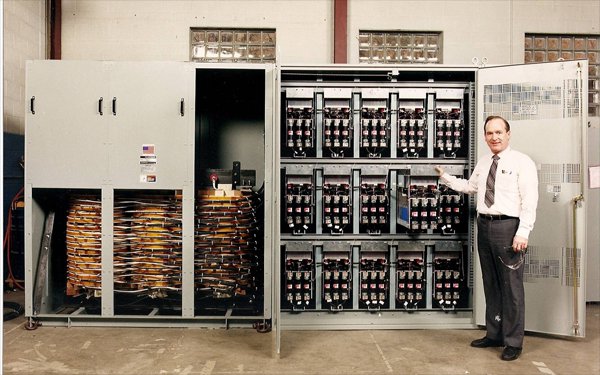
Peter Hammond reviews the birth of medium voltage inverters
Looking back at the history of the Perfect Harmony drive, you can understand how to develop products now and in the future.
Author: Technical Editor Dave Perkon
February 16, 2016
About the author
Dave Perkon Dave Perkon is the technical editor of Control Design. He has designed and managed automation projects for Fortune 500 companies in the medical, automotive, semiconductor, defense and solar industries.
Peter Hammond is the father of Perfect Harmony topology. It is the design of medium voltage (MV) and variable frequency drive (VFD) that changed the industry. With the expiration of the US patent, the topology based on the Perfect Harmony unit is the most imitated MV VFD topology in the world. More than 30 companies provide similar unit-based solutions. In fact, a large part of all MV VFDs produced globally is similar to the original Perfect Harmony topology.
Hammond's career coincides with the rise of the power electronics market. It wasn't until 1957 that GE invented the thyristor or silicon controlled rectifier (SCR) a few years later, that the market was minimal because the initial voltage and current ratings were too small. The path that the thyristor follows is similar to that of the transistor. The path was invented in 1947, but it was still immature after a few years and was not widely used.
Hammond obtained MSEE certification from the Case Institute of Technology in Cleveland in 1966, when the thyristor was mature enough to make a drive that could handle 100 hp. After graduation, he worked for many small companies that designed AC inverters.
Peter Hammond
Father of Perfect Harmony Topology
Hammond said: "In 1977, I joined a company called Robicon, which is now part of Siemens. At that time, we used thyristors to manufacture'me-too' low-voltage inverters with 600 Vac or less. Our Competitors are also making similar drives. Everyone knows that if we can go beyond the low-voltage range and enter the medium-voltage range (such as 4,160 Vac) with thousands of horsepower instead of hundreds of horsepower, there is a huge market. We have always We are looking for ways to expand the scale of existing low-voltage circuits, but there are many shortcomings."
One of the disadvantages: "If the semiconductor in a typical low-voltage circuit has the highest voltage rating, it still cannot reach 4,160 Vac," Hammond said. He said: "The second disadvantage is that as power increases, power quality becomes more and more important." "Simply expanding the existing circuit does not improve power quality."
Hammond has been studying ways to connect semiconductor devices in series to obtain higher voltages, but this is very difficult because series devices need to be turned on and off at the same time. If one device shuts down too early, the other device will need to support the entire voltage and will fail.
The birth of a journey of perfect harmony
On a weekend in 1993, Hammond proposed an idea for a new method of medium voltage drives. "Get rid of the difficulty of connecting switchgear in series, it suddenly occurred to me that it is easy to connect a complete converter in series, and it will bring a lot of side benefits." Hammond said.
Also read: The father of PLC explains its birth
click enlarge
Medium voltage drive
Medium voltage inverter birth certificate
Figure 1: The first memo disclosed to Robicon's management outlines the advantages of the drive, including efficiency, cost savings, unit power factor and reduced harmonics.
Source: Robicon / Siemens
His disclosure memorandum to managers outlines its benefits, including low harmonics, no torque ripple, quiet operation, close power factor and reduced pressure on the motor (Figure 1). These benefits will allow the installation of medium voltage drives without the use of special motors, without having to worry about torsional resonance and harmonic distortion. The management approved the project, and we ran the prototype drive in about a year. "
Hammond started working on the "Perfect Harmony" project with himself and a technician, and later added a draftsman. Hammond said: "We have been designing. Converters-we call them'batteries'. It's actually very easy, because once you decide to connect multiple low voltage converters in series to get the required medium voltage, every conversion The power required by the converter is reduced. For example, if the number of converters or units is 12, each unit only needs to provide one-twelfth of the power." If 12 units are used, only a single unit rated at 84 hp It can produce 1,000 hp of power (Figure 2).
"From our low-voltage experience, not only the circuit is familiar, but the equipment is also familiar." Hammond said. "If you want to build a low-voltage battery, you don't need high-voltage equipment. Connect the required voltage in series by connecting batteries in series (such as the batteries in a flashlight). All the equipment and circuits we use are old-style. We."
The only new problem the Hammond team needs to solve is to connect the batteries in series. Hammond said: "Batteries need electrical isolation." "This requires three things. The physical structure supporting the battery must be non-conductive, so glass fiber or other insulating materials must be used. The power supply for each battery must come from a dedicated transformer. Isolate the windings. Since the equipment cannot be transmitted over wires, we have to use optical fibers. All these electrical isolation concepts are easy to manage."
The first client was a university in Texas. The university ordered two drives for its campus air conditioning system to run the coolers. Without a VFD, the cooler must run at full speed whether it is needed or not. The university saves money by slowing down the chiller when it is cold, when full capacity is not required.
growing up very fast
"Before we even delivered the first order, an engineer from an oil company visited the witness test. The order has tested 20 low-voltage pulse width modulation (PWM) drivers to be installed on offshore oil platforms." Mond said: "These drives will operate submersible pumps, which are located in wells drilled into the seabed, one mile or more away from the platform. The customer understands that it is not feasible to transmit low-pressure power over such a distance, so he plans to Before it is sent to the subsea pump, the output of the low-voltage driver is increased through a transformer."
Unfortunately, the transformer also increases the harmonics and voltage step of the drive. "If the voltage steps in your waveform are large, then each of these steps will send a traveling wave on the cable. When it reaches the subsea pump motor at the far end, the wave will be reflected back, making The voltage step doubles." Hammond said. "With a few thousand volts as the step length, you will indeed put pressure on the insulation of the motor. If the subsea motor fails, the cost of recycling and replacing it is very high."
“Despite the penalty, the customer’s engineer saw the Harmony VFD prototype and cancelled the low-voltage order. On the contrary, he ordered 21 Perfect Harmonies even though we did not operate on site.” Hammond said (Figure 3). "This is our second order. Our sales team estimated that only two Harmony hard drives were sold in the first year, but in the end 47 units were sold. We knew it was a success."
Hammond pointed out that although the ideal output voltage is an ideal sine wave, the ideal harmonics are still very close because it can synthesize the output voltage through many small steps, which approximates the sine wave very well. He said: "This is the favorite feature of oil companies. In addition, the power supply on oil platforms is diesel generators, which have high impedance, so they cannot withstand harmonics well. PerfectHarmony's harmonics are very low. Input and output. "
The third benefit that oil companies have not taken advantage of is battery redundancy. Hammond said: "Since we divide the power supply circuit into many identical units, we can bear the loss of one loss, and if a simple unit bypass function is added, the driver can still work." "Although the output voltage waveform has some subtleties But it’s much better than not being able to run at all. A defective battery can be replaced at convenience."
Large blowers in power stations take advantage of this advantage. These 5,000 hp blowers force air into the boiler and exhaust the exhaust gas, sending it into the chimney. If one blower goes out, the entire power plant will be shut down. Always specify the bypass option in such high reliability applications. High reliability requirements are another reason why Perfect Harmony drives are also used in pipeline pumps and petrochemical plants.
Want more? View our state of technology report: PLC and PAC
Path of least resistance
Hammond said: "The important event in my life that pointed to electrical engineering happened in 1954 when I was in the eighth grade." "I lived on a farm and went to school in a small town. On Halloween, the local businessman had trouble. At that time, their windows would be painted with soap or graffiti. They decided to participate in the competition and let the students draw Halloween scenes on the windows. My prize was to go to the library to choose a book. I chose a book. It’s called "Boys and Batteries." There are a bunch of simple electrical experiments that boys can do. I think this first made me interested.
Hammond received the National Merit Scholarship, so he was able to go to the California Institute of Technology in Pasadena and received a bachelor's degree in electrical engineering in 1962. "I worked for a year and then returned to the graduate school of Case Institute of Technology in Cleveland, Ohio. In 1966, I received an MSEE degree. Then, I entered the power electronics industry and have stayed there ever since."
Hammond entered Robicon when he first decided to get involved in the AC inverter business in 1977. Robicon entered the market later and chose to use a current-fed inverter design with SCR. "I entered the first floor there, where my boss and I designed most of the drives in that low-voltage home. Soon after joining Robicon, President Carter passed Congress legislation to fund municipal wastewater upgrades across the country. This Created a broad market for variable speed drives. The joke is that we started with manure pumping. This is a low-pressure drive, but we have learned a lot from the installation of the sewage lifting station."
Dangming is already a blockbuster
Hammond explained: “The size of the motor and pump in the sewage lifting station must be designed to achieve the worst-case flow rate under thunderstorms.” “Under normal conditions, the flow rate will be greatly reduced if the motor and pump continue to run at full speed. Running, their efficiency will be very low. With variable speed drives, the speed can be optimized for the actual flow, which saves a lot of energy."
"So far, perfect harmony has been 20 years, it is still competitive, and it is still the same path. Topology still has a lot of life."
-Peter Hammond
Sewage lifting stations are distributed in all the communities they serve, so they get electricity from the same public grid as residents. Hammond explained: "Early low-voltage drivers absorbed a lot of harmonic currents from the grid, resulting in harmonic voltage distortion." "Resident neighbors complained that their televisions were flickering and their phones were humming."
To reduce these problems, Robicon used a small transformer to test the phase shift between the drivers. This eliminates some harmonic currents and reduces distortion. Hammond said: "This is the first step in our later introduction of the problem of perfect harmony-eliminating harmonics by phase shifting."
Another shortcoming of early drivers is that when the motor speed decreases, the input power factor decreases. Hammond said: "The current consumed by the drive exceeds the current required because some of the current is reactive and because it is not in phase with the voltage, the current is not doing useful work." "Utilities will suffer from poor power factor. Being punished, Robicon developed filters that can reduce harmonic distortion and correct power factor."
Hammond pointed out that at first, there were few variable speed drives in operation, so the harmonic problem was not serious. There are few complaints. However, as more and more drives are installed, it becomes important. IEEE issued Standard 519 to limit the allowed harmonic distortion. By the mid-1980s, almost every drive order needed to minimize harmonics and power factor correction.
Hammond said: "Robicon's AC drive sales increased from zero in 1977 to about 20 million US dollars in 1993." "Then, when "Perfect Harmony" came out, sales exploded. By 1997, our sales reached $200 million."
The road to perfect harmony
The simple description of a harmonic drive is a set of units with rectifiers that take three-phase AC voltage from a special transformer and convert it to DC voltage. Then, a PWM inverter is used to convert the DC voltage into AC voltages of different frequencies within the unit. Inverters are a bit more complicated than rectifiers because the output switch needs to be controllable-in this case, insulated gate bipolar transistors (IGBT) are used. The unit in Perfect Harmony contains a rectifier, a set of capacitors to filter DC power and inverter equipment.
In Harmony drives, the number of units is always a multiple of 3 to generate a three-phase output voltage. The number of batteries per phase depends on the maximum output voltage required. Since the battery cell contains a capacitor bank, it does not need to be switched at the same time. Switching these units at slightly different times reduces the step size of the output voltage and increases the number of steps. By controlling the timing of many small steps instead of a few large steps, the output voltage can approximate a sine wave very well.
old age
Hammond said: "Our early experience was low pressure." "When we entered the medium voltage market, we had a lot to learn to do. Fortunately, we proceeded cautiously. The original drive was made like a fuel tank, but it was expensive. And it’s huge. Over time, the housing has become more and more sturdy. It has been reduced a bit, but the work is still done. Now we are in the third or fourth generation of drives."
In 2005, Robicon was acquired by Siemens. The only product Siemens wants is perfect harmony. All other products are sold out. Hammond retired at about the same time, but continued to work part-time as a senior consulting engineer for Siemens.
"When Perfect Harmony first appeared, our expectation was that the new product could only be used for 10 years, and we needed to start replacing it immediately," Hammond said. "But so far, Perfect Harmony is still competitive and still on the same track. Topology still has a lot of life, and it is still manufactured in Pittsburgh, Pennsylvania. There will be a new medium voltage drive design or concept capable of Beyond perfect harmony. We just haven't seen it yet."
Medium pressure
But the plasma arc is larger
In order to emphasize the need for arc flash protection, most voltage levels higher than 30 V are first considered dangerous, but at medium voltage levels (600 V to 69 kV), the danger increases, and the energy of the plasma arc also increase. For example, for a plasma arc, the break point is 600V between low and medium voltage. Below 600 V, if there is an arc starting, it will usually extinguish itself, because when the AC voltage is zero, unless it may be an arc welder, the arc will stop. Above 600 V, this will not happen. Now you may crash, sometimes even explode. This has increased the requirements for the medium voltage world, such as arc-proof enclosures.
When an arc occurs, it is almost like an explosion because a large amount of power is injected into the arc. This is a potential problem for all medium voltage applications. The gas or plasma must be vented to prevent the cabinet from cracking. This requires the work of a rupture disk and possibly a catheter to deliver the plasma to a safe area. Another problem is radiation. A lot of energy is concentrated in the area where the arc occurs, so that a lot of radiant heat and ultraviolet rays are emitted, which can cause sunburn all over the body in an instant. Rain-proof clothing and helmet are required. Wear arched arc protection equipment with appropriate ratings, as it may prevent you from reaching the evaporation temperature during the arc.
Perfect harmony topology
Perfect harmony topology
Figure 2: The basis of the Perfect Harmony medium voltage variable frequency drive is a special transformer and multiple batteries connected in series.
Source: Peter Hammond
We are the world's leading supplier of spare parts for medium voltage drives of various brands

点击右上角
分享给朋友吧
GET IN TOUCH

East Sun Industrial Centre, No 16 Shing Yip Street Kl, Hongkong

Call us : +852 5261 7322

Email us : [email protected]
SITEMAP
BUSINESS HOURS
Monday to Friday : 9 am to 6 pm
Saturday : 9 am to 12 am
Sunday : Closed Support Hours in 24/7 Everyday
DISCLAIMER:
We are not an authorized distributor, reseller or representative of the following products presented on this website. All Product names and logos throughout this site are trademarks of their respective holders. Use of them DOES NOT imply any affiliation with or endorsement by them.
© 2020 robiconperfectharmony.com site . All rights reserved Site Map
